
Mold Testing — Lead Generation Landing Page for California
Advertising landing page for a local mold inspection service with conversion-focused structure and visual enhancements
Role: Structure, design, and WordPress development · Year: 2025 · Stack: WordPress / Astra Pro / Elementor
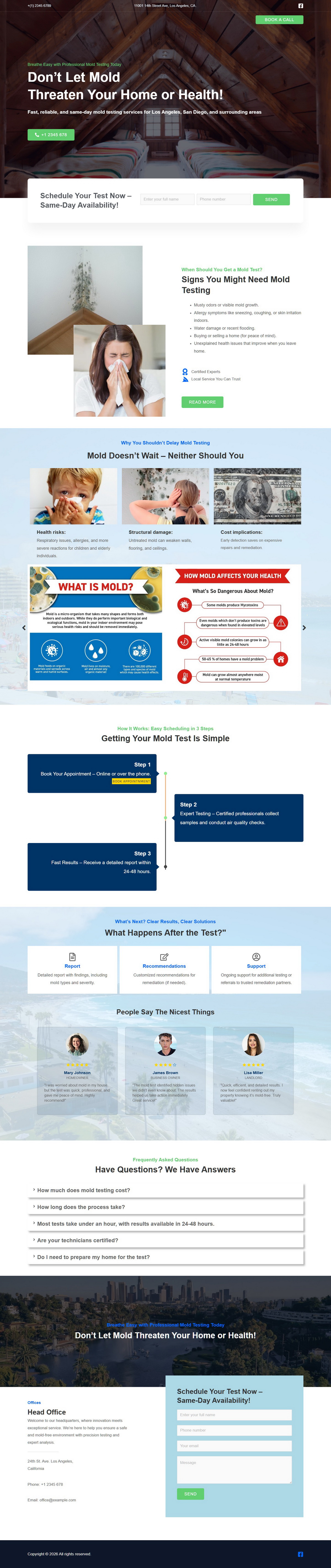
Mold testing landing page for local advertising campaigns in California
Year: 2025
Project type: advertising landing page (Google Ads / PPC)
Platform: WordPress
Stack: Astra Pro / Elementor
Context: local lead generation campaign for California
{/}
Project context
This landing page was developed for a PPC specialist managing advertising campaigns for a client in California, USA.
The project targeted local lead generation for mold testing and inspection services in the Los Angeles area.
Unlike projects with predefined wireframes or approved design systems, this one followed a much more fluid process.
No design mockups, page structure, or detailed technical specifications were provided. Instead, development evolved iteratively: sections, visual elements, and layout decisions were proposed during implementation and added based on client feedback and approval.
The result was not a strict execution of a design document, but a practical advertising landing page shaped gradually through an iterative workflow and direct client feedback.
{?}
Task
The goal was to create a landing page suitable for paid traffic campaigns that would:
- present a local service clearly and quickly;
- establish trust through recognizable visual patterns;
- provide immediate contact options;
- explain the service process and health-related context;
- maintain a straightforward conversion flow;
- remain usable on both desktop and mobile devices.
Since this was an advertising page rather than a corporate website, the emphasis was placed on clarity and practical structure rather than extensive functionality.

Mobile · Mold Testing California Landing
{#}
Structure and implementation
The page was built on WordPress using Astra Pro and Elementor with additional Elementor extensions.
The implementation included standard landing page sections:
- hero section with lead form and CTA;
- informational content explaining mold-related risks;
- visual infographic sections;
- service process timeline;
- testimonials carousel;
- FAQ section;
- repeated contact blocks throughout the page.
Development was initially performed on the contractor’s hosting environment and later cloned to the client’s hosting and domain on GoDaddy.
{%}
Visual and technical details
Several additional elements were introduced to make the page feel less static and improve visual flow:
- hero section implemented as a slider with fade transitions;
- Ken Burns effect (subtle zoom animation) applied to hero background images;
- infographic materials displayed through an image carousel;
- light blue overlay treatment over Los Angeles beach photography in selected sections;
- fixed background panoramic image with dark overlay creating a parallax-like scrolling effect.
Outside of these additions, the overall implementation remained intentionally lightweight and conventional.
The project relied on familiar conversion-oriented landing page patterns commonly used in local service advertising rather than custom interactive functionality.
{!}
Result
The client received a campaign-oriented landing page suitable for local advertising use.
The project provided:
- a clear lead-generation structure;
- multiple contact opportunities throughout the page;
- visual enhancements without excessive complexity;
- mobile-friendly layout behavior;
- a reusable structure for future service campaigns.
The original version of the page appears to remain online.
At the same time, the live version still contains placeholder contact details and default demo information, suggesting that the advertising campaign may never have entered active use.
{+}
Notes
Not every commercial project starts with polished Figma files and detailed documentation.
This case reflects a more common real-world workflow: ideas emerge during implementation, structure evolves iteratively, and decisions are made directly in the process.
For local advertising pages, predictable structure and speed of execution often matter more than visual experimentation.
This reflects a common advertising workflow where implementation often evolves together with business decisions.
{*}
<contact_me>
…If you’d like to discuss a project, clarify requirements, or explore possible collaboration, you can find all contact details on the contact page.